Editor & Proofreader

Editor: Nelson Poirier    Proofreader: Louise Nichols

Saturday, 1 March 2025

March 1 2025


NATURE MONCTON NATURE NEWS

March 1 2025 

Nature Moncton members as well as any naturalist in New Brunswick or beyond are invited to share their photos and descriptions of recent nature sightings to build a fresh (almost) daily edition of Nature News


To respond by e-mail, please address your message to the information line editor,  nelsonpoirier435@gmail.com .


Please advise the editor at nelsonpoirier435@gmail.com  and proofreader Louise Nichols at Nicholsl@eastlink.ca if any errors are noted in wording or photo labelling.


For more information on Nature Moncton, check the website at 
www.naturemoncton.com.


Proofreading courtesy of Louise Nichols

nicholsl@eastlink.ca


**Richard Blacquiere comments that American robins were very rare through the winter in Hampton, probably related to the lack of a wild fruit crop in this part of NB. Very occasionally, one would fly through, but apparently,  there wasn’t much to encourage them to linger. That probably applies to cedar waxwings as well. The waxwing in the photo was part of a flock of nine, the first waxwings Richard has seen around Hampton in a few months. 

Recently, warmer temperatures and rain started to open up some patches of water, which were quickly occupied by waterfowl. A wood duck was a nice surprise among the mallards and American black ducks; Richard suspects it is the same one that was around till the pond froze over at the beginning of winter and managed to survive somewhere not far away. One of the mallard ducks had some unusual plumage characteristics that made it stand out from the others. Rather than a hybrid, Richard thinks this is more likely a male delayed in its moult cycle and still in definitive alternate ("eclipsed") plumage. It would be interesting to know what this bird will look like in a couple of months.


**Jean and Jim Wilson spent the day Friday roaming from Sussex to Fundy Park to Waterside, Riverside-Albert and home over Caledonia Mountain, Salisbury and Sussex.

Aside from a modest list of 30 bird species they were delighted to get good looks at a fisher in Fundy Park, about halfway from the Park entrance and the lookoff that gives the panoramic view of Cape Enrage and the rest of the Bay of Fundy. The fisher appeared to have crossed the road just before they came into sight and was on the snowbank on the left side of the road. As their car approached, it quickly ran into the woods; when they stopped to look at its tracks, there was also a set of fresh prints of a snowshoe hare, suggesting the fisher might have been following them. Unfortunately, it all happened too fast for a photo. They had also seen a large coyote cross the road in front of them about five minutes earlier.

(Editor’s note: An interesting follow-up to Jim’s fisher comments comes from Frank Branch observing tracks/trails in his Paquetville woodlot where a fisher is more likely to be observed. That generated several opinions from people who felt that what Frank had observed was a bounding canine. In those consultations, Brian Donovan shared some photos he had taken in the Renous highway area of fisher tracks/trail that are added today. Many New Brunswick naturalists have good observations of the fisher on their bucket list, with some lucky ones having crossed that off the list.)


**As Brian Coyle was driving along the Salisbury Road in the Boundary Creek area, he spotted a mature bald eagle flying towards the Petitcodiac River with a very large stick in its talons. Nest renovations are underway.

Just before going to bed Friday night, Brian found two lively northern flying squirrels at his peanut butter and suet feeders 20 feet off the ground. Check out the action in the attached video. One of the pair ends up launching itself into the night.


VID20250228203531.mp4


Brian comments that he really has to clean the peanut butter spatter off that window!

(Editor’s note: just don’t disturb those flying squirrels, Brian!)


**To remind folks to check for observations of the planet Mercury, I am repeating Curt Nason’s words. If the dusk sky is clear, it will be a great opportunity to see Mercury with binoculars. Brian Stone shares a screenshot that may help neophyte astronomers find it.


Screenshot_20250228-202305~2-3


”Mercury is in its best evening apparition for the year, appearing higher in the west each evening while Venus lowers, and by next weekend they will be five degrees apart. As Venus nears setting, Jupiter rides high in the northwest”


**Bob Blake maintains weather statistics from his Second North River home, including morning low temperatures, daily high temperatures, and monthly precipitation.

Bob sends a table comparing those February 2024 statistics with those of February 2025.

Bob’s record for February 2025 showed a higher number of lower morning temperatures than that of 2024. In 2024, much more precipitation fell as rain at 68 mm;  in 2025, we received only 3mm of rain. Snow levels did not differ by much.


2024

2025

morning temperatures

daily highs and rainfall

morning temperatures

daily highs and rainfall

-17-1 day

-16-2

-13-3

-9-3

-7-2

-6-3

-4-3

-2-2

-1-4

0-1

+1-1

+8-1


 +10-1

+7-1

+6-1

23 cms. snow

68 mms. rain

-19-1

-18-2

-17-

-16-1

-15-2

-13-1

-12-2

-11-2

-10-1

-9-5

-8-1

-5-1

-4-3

-2-1

+2-1

+3-2


+10-1

+7-1

+6-1

30 cms. snow

3 mms. rain


Nelsonpoirier435@gmail.com

 Nelson Poirier

Nature Moncton


WOOD DUCK. FEBRUARY 28, 2025. RICHARD BLACQUIERE


MALLARD (MALE IN ECLIPSED PLUMAGE). FEBRUARY 28, 2025. RICHARD BLACQUIERE 


CEDAR WAXWING. FEBRUARY 27, 2025. RICHARD BLACQUIERE


AMERICAN ROBIN. FEBRUARY 26, 2025. RICHARD BLACQUIERE


FISHER TRACK-TRAIL. BRIAN DONOVAN


FISHER TRACK. BRIAN DONOVAN


Friday, 28 February 2025

February 28 2025


NATURE MONCTON NATURE NEWS

February 28, 2025


Nature Moncton members as well as any naturalist in New Brunswick or beyond are invited to share their photos and descriptions of recent nature sightings to build a fresh (almost) daily edition of Nature News


To respond by e-mail, please address your message to the information line editor,  nelsonpoirier435@gmail.com .


Please advise the editor at nelsonpoirier435@gmail.com  and proofreader Louise Nichols at Nicholsl@eastlink.ca if any errors are noted in wording or photo labelling.


For more information on Nature Moncton, check the website at 
www.naturemoncton.com.


Proofreading courtesy of Louise Nichols

nicholsl@eastlink.ca


**On February 25, 2025, while snowshoeing out to a trail camera, Brian Coyle came upon a muskrat scurrying about on top of the snow crust. He was surprised to see it out in the open and in broad daylight, as the mating season for muskrats is not until around the end of April. It had made its way across 200' of field, entered the woods, and then came back across the field. It then headed for a ditch with some open water to make its escape.

Brian was able to capture an excellent video of the muskrat. Check it out at the link below:

VID20250225115530.mp4

(Editor’s note: when it comes to identifying mammal tracks/trails, it doesn’t get much better than this when you are able to see the subject making the tracks!)

Brian was out to a beaver pond Thursday morning, with the very light snowfall from overnight on top of the crust. There, he spotted the tracks of a red fox. The individual footprints measure approximately 1 1/2" long and 1 1/4" wide, with a 12" gait.

On Tuesday, February 25, 2025, Brian Coyle had a sudden influx of birds to his backyard feeders. There was a flock of approximately 25 American goldfinch, along with approximately 20 evening grosbeaks.  There was also the resident pair of brown creepers, who are always present on his backyard spruce trees.

(Editor’s note: Brian certainly had a great few days making nature observations and being able to share them with photographs. The “portraits” of the evening grosbeak and brown creeper give great detail. That beak shows good reason for the grosbeak name. Note that the brown creeper photo nicely shows it using its stiff tail to brace itself against tree bark as it forages, a trait it shares with woodpeckers.)


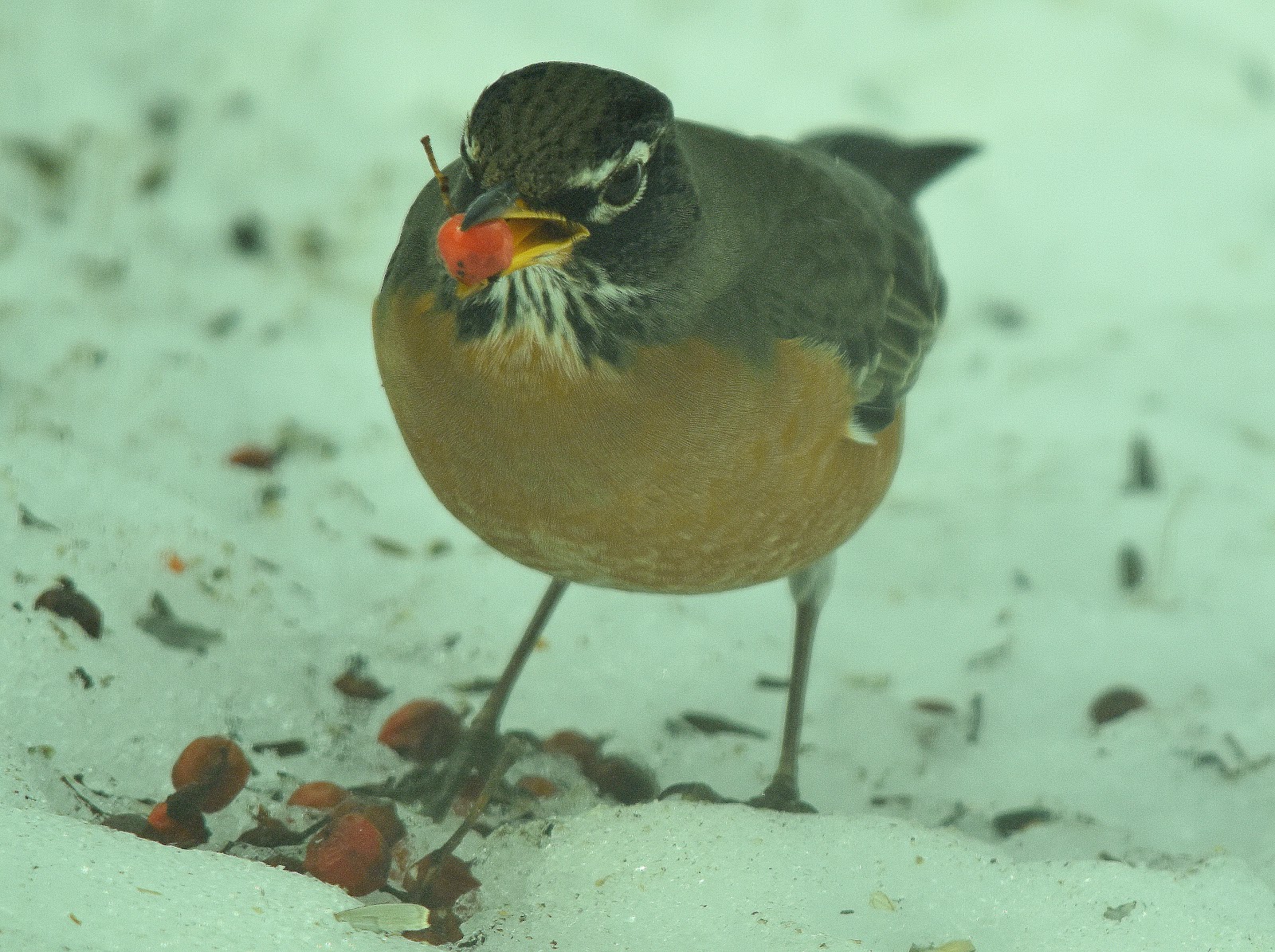
**Jane LeBlanc noticed three American robins in her yard Thursday, enjoying the mountain ash berries. The hermit thrush has not been seen for a while, so Jane fears the worst.

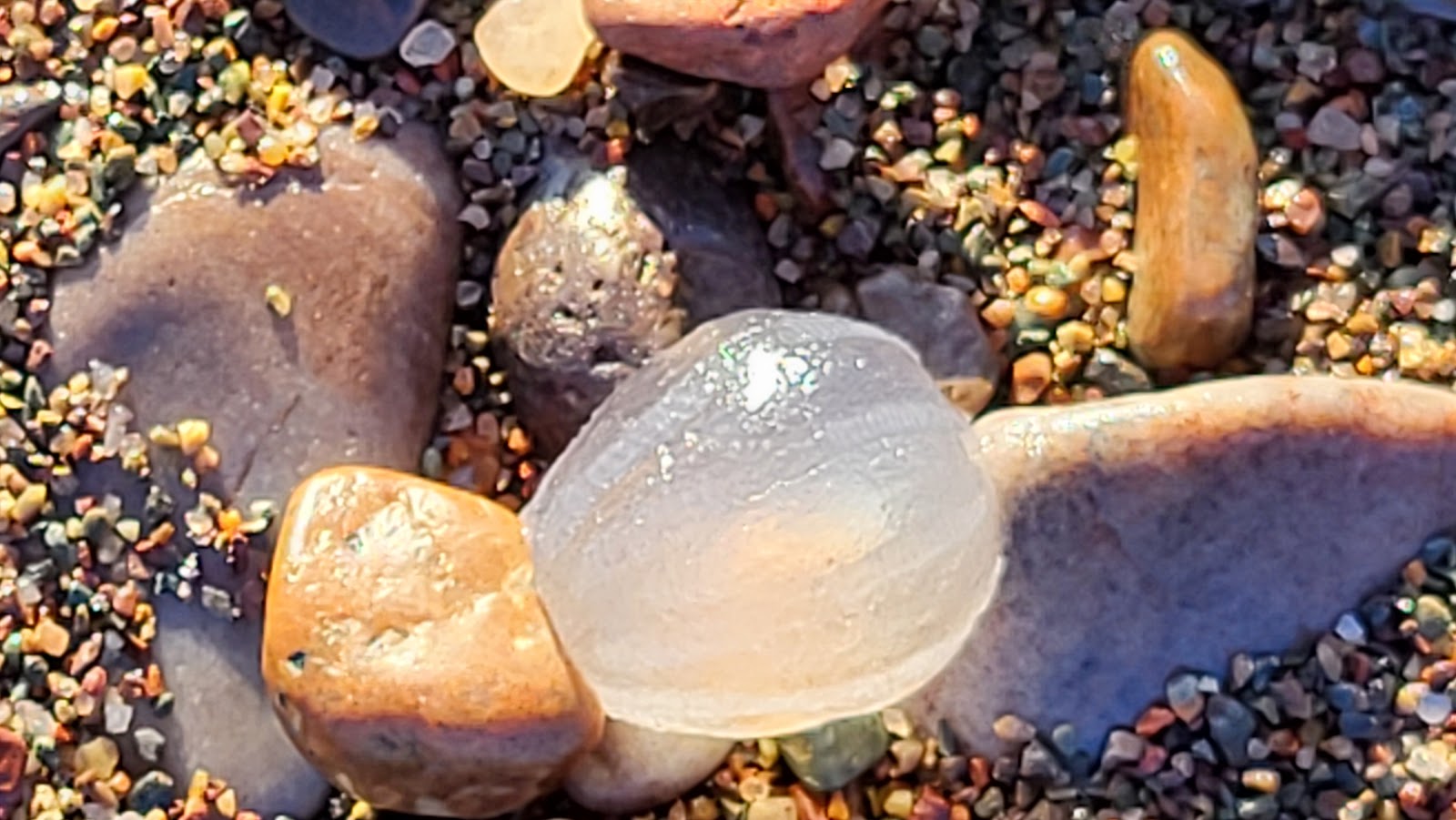
Jane also photographed a dime-sized gelatinous object washed up on the St. Martins Beach.

Don McAlpine at the New Brunswick Museum confirmed it as a comb jelly (phylum Ctenophora).

(Editor’s note: These are very interesting underwater invertebrate creatures that are common, but we will very rarely see them due to their underwater habitat. The specimen in Jane’s photo is dead, but live specimens are more colourful, showing an iridescent eight rows of tiny comb-like plates of cilia (hair-like structures) for swimming. They are in a different phylum with different life histories from what we know as true jellyfish.

I recall a chap who fished smelt through the ice in the winter in the Cocagne area, noticing a number of these clinging to his nets and wondering what they were. We were able to confirm them at the time as comb jellies. They must be very tolerant of cold-water temperatures.)


**This Week’s Sky at a Glance, 2025 March 1 – March 8
This week we will take the path less travelled to pick out a few of the more obscure constellations in our sky.  If you don’t have a clear view to the south or if you are cursed by light pollution in that direction, they will be obscure to the point of invisibility. Around 9 pm, cast your eyes toward Sirius in Canis Major, the Big Dog. Hugging the horizon below Sirius you might detect a Y-shaped group of stars that forms Columba the Dove. This is one of the later constellations, created a century after Christopher Columbus made his first voyage, and it was meant to depict a dove sent by another famous sailor called Noah. It could also be the dove released by yet another famous sailor, Jason of the Argonauts fame, to gauge the speed of the Clashing Rocks of the Symplegades. The dove lost some tail feathers and the Argo lost a bit of its stern.

There is a good case to be made for this interpretation. To the left of Columba, rising past the rear end of Canis Major, is the upper part of Puppis the Stern. It was once part of a much larger constellation called Argo Navis, Jason’s ship, which has been disassembled to form Puppis, Vela the Sails and Carina the Keel. To the left of Puppis is a vertical line of three stars forming Pyxis, the (Mariner’s) Compass, and some say it once formed the mast of Argo Navis. At its highest it does point roughly north-south.

This Week in the Solar System
Saturday’s sunrise in Moncton is at 6:57 and sunset will occur at 6:05, giving 11 hours, 8 minutes of daylight (7:01 and 6:11 in Saint John). Next Saturday the Sun will rise at 6:44 and set at 6:15, giving 11 hours, 31 minutes of daylight (6:49 and 6:21 in Saint John).

The Moon is near Venus this Saturday, between Jupiter and the Pleaides on Wednesday, and it is at first quarter Thursday when telescope users can spot the Lunar X within the shadow in early evening. Mercury is in its best evening apparition for the year, appearing higher in the west each evening while Venus lowers, and by next weekend they will be five degrees apart. As Venus nears setting, Jupiter rides high in the northwest above the V-shaped Hyades cluster, while Mars is higher in the south triangulating with the Gemini twins. Beginning 7:37 pm on Tuesday, telescope users have an hour and a half to watch the shadows of Jupiter’s moons Europa and Ganymede crossing the planet at the same time. Saturn is lost in evening twilight.

The Saint John Astronomy Club meets in the Rockwood Park Interpretation Centre this Saturday at 7 pm. Tune in to the Sunday Night Astronomy Show at 8 pm on the YouTube channel and Facebook page of Astronomy by the Bay.

Questions? Contact Curt Nason at nasonc@nbnet.nb.ca.


 Nelsonpoirier435@gmail.com

 Nelson Poirier

Nature Moncton


BROWN CREEPER. FEBRUARY 25, 2025. BRIAN COYLE


EVENING GROSBEAK (FEMALE). FEB 25, 2025. BRIAN COYLE


EVENING GROSBEAK (MALE). FEB 25, 2025. BRIAN COYLE


AMERICAN ROBIN. FEB. 27, 2025. JANE LEBLANC


MUSKRAT TRACKS. FEBRUARY 25, 2025.  BRIAN COYLE


MUSKRAT TRACKS. FEBRUARY 25, 2025.  BRIAN COYLE


RED FOX TRACKS. FEBRUARY 27, 2025. BRIAN COYLE


RED FOX TRACKS. FEBRUARY 27, 2025. BRIAN COYLE


COMB JELLY (PHYLUM CTENOPHORA). FEB 27, 2025. JANE LEBLANC


Pyxis


Wednesday, 26 February 2025

February 27 2025


NATURE MONCTON NATURE NEWS

February 27, 2025


Nature Moncton members as well as any naturalist in New Brunswick or beyond are invited to share their photos and descriptions of recent nature sightings to build a fresh (almost) daily edition of Nature News


To respond by e-mail, please address your message to the information line editor,  nelsonpoirier435@gmail.com .


Please advise the editor at nelsonpoirier435@gmail.com  and proofreader Louise Nichols at Nicholsl@eastlink.ca if any errors are noted in wording or photo labelling.


For more information on Nature Moncton, check the website at 
www.naturemoncton.com.


Proofreading courtesy of Louise Nichols

nicholsl@eastlink.ca


**The annual ever-popular Nature Moncton birdfeeder tour will take place on Saturday, March 8. A complete write-up is below.

NATURE MONCTON BIRD FEEDER TOUR
Saturday, March 8, 2025 (with a weather date of Saturday, March 15, 2025)

Nature Moncton’s annual bird feeder tour will take place on Saturday, March 8th. Participants are asked to meet at 8:30 AM at the Superstore on Main Street near the Dollarama. Carpooling can be discussed at that time. 

The first stop will be the Richards in Taylor Village to see the many birds in their well-stocked feeder yard while socializing over a delicious pot-luck breakfast. Participants are asked to bring food contributions, and if your contribution is not fully consumed, please take the leftovers on to the final stop and if still leftovers, take them home with you.  After leaving the Richards’, the group will travel to Memramcook and the home of Yolande and Eudor Leblanc and hopefully see some of the great assortment of patrons that regularly hang out there. Next, we go on to Fred and Lynn Dube’s in Lower Coverdale.  We will end the afternoon at Nelson Poirier’s back in Moncton for further socializing over coffee/tea and snacks. Come and enjoy a day with fellow birding enthusiasts along with the excitement of seeing what turns up at the visited feeders.

          Due to space restrictions, we will have to limit the number of attendees. Please contact Fred Richards at 506-334-0100 or email fred.j.richards@gmail.com to reserve a spot.

(Use this number any time during the day to find out where the group is and join in.)

 Members can reserve anytime, but non-members cannot register until March 3rd.  Directions to follow.  Stay tuned.


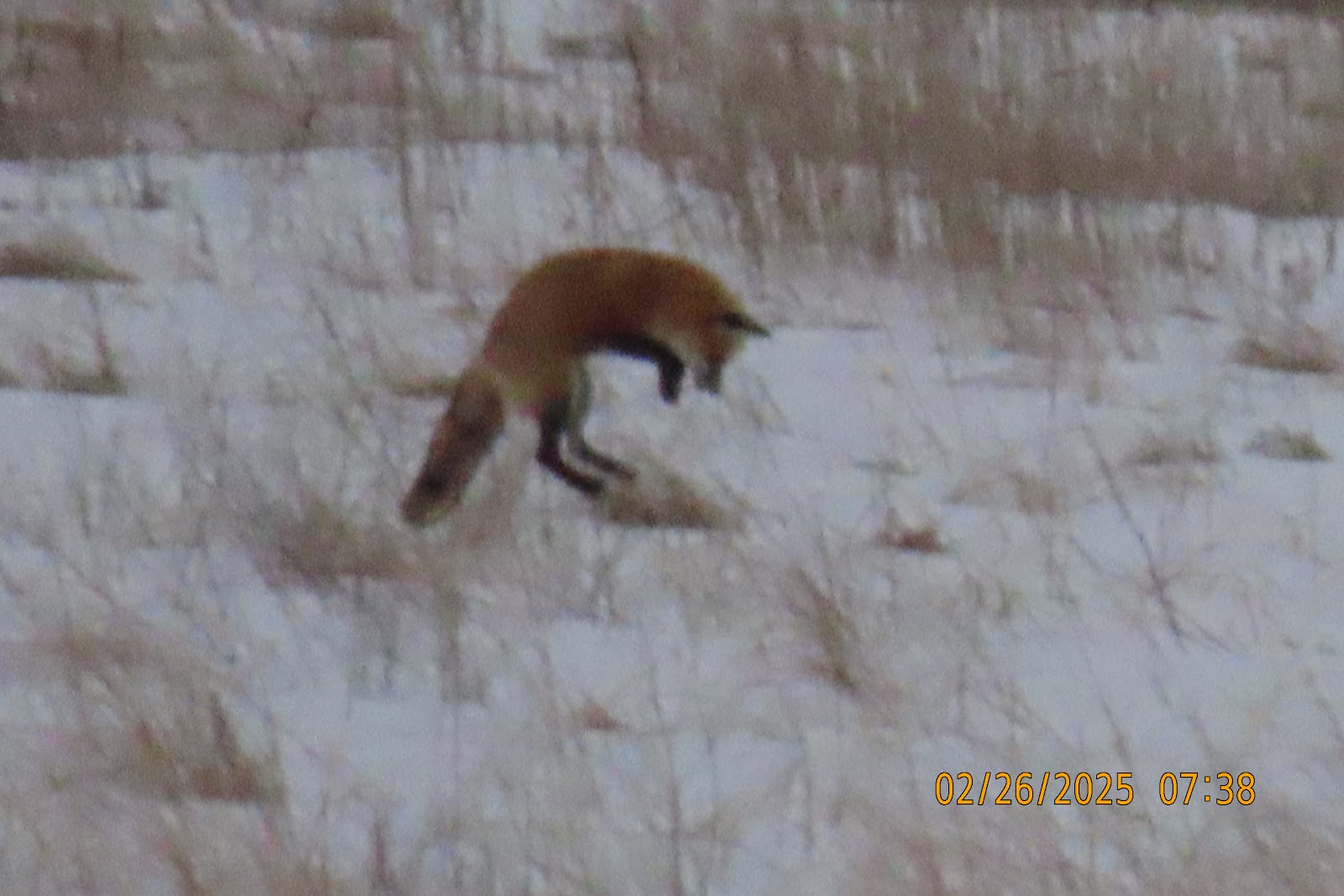
**The warmer temperatures brought out a red fox on the Riverview marsh across from Halls Creek.  Georges Brun was able to photograph it doing the Yosemite Sam high jump and rewarded with its prey.

Downriver on the Petitcodiac River, as the tidal bore was moving upriver, a lone male northern shoveler was observed.  

red-tailed hawk flew over A&W, then headed across Champlain toward the entrance to Wheeler Blvd, and landed in the spruce trees.  Georges saw the bird only because the crows spotted it quickly to enjoy a harassing session.


**Golden-crowned kinglets have had a good year if reports are indicative of them appearing around bird feeder yards.

Fred Dube had a camera aimed at the right time to manage to get three golden-crowned kinglets together in one view on the ground  to flash their golden crowns.

Fred also photographed one of their regular brown creepers enjoying suet, as well is a dark-eyed junco surveying the menu.


Nelsonpoirier435@gmail.com

 Nelson Poirier

Nature Moncton


GOLDEN-CROWNED KINGLETS. FEB 26 2025. FRED DUBE


BROWN CREEPER. FEB 26, 2025. FRED DUBE


DARK-EYED JUNCO. FEB 26, 2025. FRED DUBE


RED FOX. FEB. 26, 2025. GEORGES BRUN


RED FOX. FEB. 26, 2025. GEORGES BRUN


RED FOX. FEB. 26, 2025. GEORGES BRUN


RED FOX. FEB. 26, 2025. GEORGES BRUN


GREY SQUIRRELS. FEB 26, 2025. FRED DUBE


February 26 2025

NATURE MONCTON NATURE NEWS

February 26, 2025


Nature Moncton members as well as any naturalist in New Brunswick or beyond are invited to share their photos and descriptions of recent nature sightings to build a fresh (almost) daily edition of Nature News


To respond by e-mail, please address your message to the information line editor,  nelsonpoirier435@gmail.com .


Please advise the editor at nelsonpoirier435@gmail.com  and proofreader Louise Nichols at Nicholsl@eastlink.ca if any errors are noted in wording or photo labelling.


For more information on Nature Moncton, check the website at 
www.naturemoncton.com.


Proofreading courtesy of Louise Nichols

nicholsl@eastlink.ca


**The annual ever-popular Nature Moncton birdfeeder tour will take place on Saturday, March 8.  A complete write-up will be available tomorrow morning.


**Reports of the northern mockingbird would appear to be down in numbers this season; however, Pat Fox has a northern mockingbird coming to her Riverview feeder yard and enjoying peanut butter.


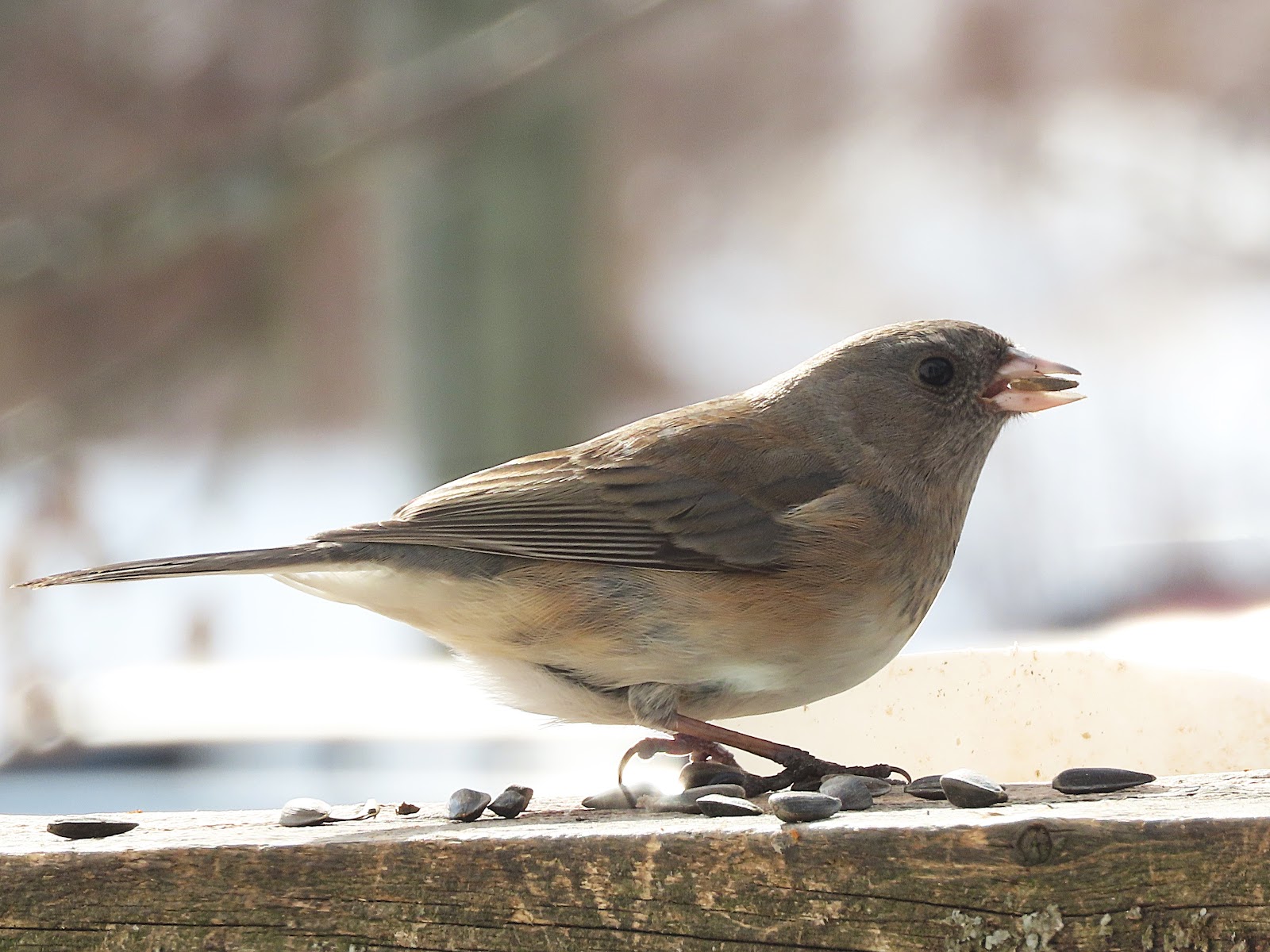
**The dark-eyed junco usually prefers feeding on the ground at birdfeeders. John Inman has a female dark-eyed junco (photo attached) that has seemed to prefer aboveground spread food feeder all winter rather than the ground spread seed like the rest of them, and a swamp sparrow continues to visit for a while longer before it heads off to a nesting territory.


**Elaine Gallant watched a ruffed grouse on Tuesday morning in an urban front yard in West Riverview as it spent most of the day under a large blue spruce.


**Mason bee nest boxes

Fred Dube has built a batch of mason bee nest boxes for Nature Moncton, with a photo attached below.

The units are 5 ½ in. long and 3 ½ in. square with the nest holes 5 in. deep and 5/16 in. diameter to meet suggested preferences for mason bees. The donation price is $10 each and the boxes will be available at Nature Moncton events or can be picked up in town by emailing nelsonpoirier435@gmail.com.

Mason bees are very significant pollinators and are one of the first bee species out on their reproductive mission in spring. They are valuable pollinators in the first warm days of spring and complete their mission over two to four weeks.

The mason bee is a solitary bee yet is attracted to the series of holes these man-made structures provide. They approximate the size of a housefly and are nonaggressive. It is suggested the structures be placed with a southeast exposure to get maximum warmth from the sun for early spring nest preparation. These structures should be up and in place by April 1st due to the early spring activity of the species that will fill each hole with five chambers divided by a mud cap and, when full, seal the hole with mud. The young will emerge the next spring.


MASON BEE NEST BOX. FEB 24, 2025. NELSON POIRIER


Nelsonpoirier435@gmail.com

 Nelson Poirier

Nature Moncton


NORTHERN MOCKINGBIRD. FEB 25, 2025.  PAT FOX


NORTHERN MOCKINGBIRD. FEB 25, 2025.  PAT FOX


SWAMP SPARROW. FEB 25, 2025. JOHN INMAN


DARK-EYED JUNCO (FEMALE). FEB 25, 2025. JOHN INMAN


RUFFED GROUSE. FEB 25, 2025. ELAINE GALLANT