NATURE MONCTON INFORMATION LINE, May 3, 2021 (Monday)
To respond by email, please address your message to
the information line editor, nelsonpoirier435@gmail.com
Please advise the editor at nelsonpoirier435@gmail.com if any errors are noted in wording
or photo labelling.
For more information on Nature Moncton, check the
website at www.naturemoncton.com
Edited by: Nelson Poirier nelsonpoirier435@gmail.com
Transcript by Susan Richards susan_richards@rogers.com
Info Line #: 506-384-6397 (384-NEWS)
**Frank Branch was able to get some distant but very
identifiable photos of an adult male TUFTED
DUCK [Fuligule morillon] at the
Tracadie lagoon that was found by Jolande St-Pierre and Denise Godin. The tuft streaming from the crown shows
nicely in Frank’s photos, as well as the sharp delineation between the white
side and black mantle in one picture.
The Tufted Duck is an Old World species and a special rare visitor to
New Brunswick.
**Apparently there is more than 1 GOLDEN-CROWNED SPARROW [Bruant à couronne dorée] at the moment in New Brunswick.
Rick Elliot noted a major migration along the Fundy
coast on Sunday and among them was an adult Golden-Crowned Sparrow. Unfortunately, the area is not accessible to
the public but sure interesting to know New Brunswick is hosting 2 of these
rarities at the moment.
**It is going to happen again! The early hummingbirds
have arrived.
John
Inman got a photo of his first RUBY-THROATED HUMMINGBID getting a quick meal
and moving on. It is the same scenario as last year as they had a number of hummers
get a quick meal and move on, before they had one take up residence showing it
is helpful to have feeders out a little early.
Also, a SHARP-SHINNED HAWK has been enjoying a
regular meal of John’s abundant blackbird patrons.
**Shortly before 8 PM, on May 2, Dave Christie had
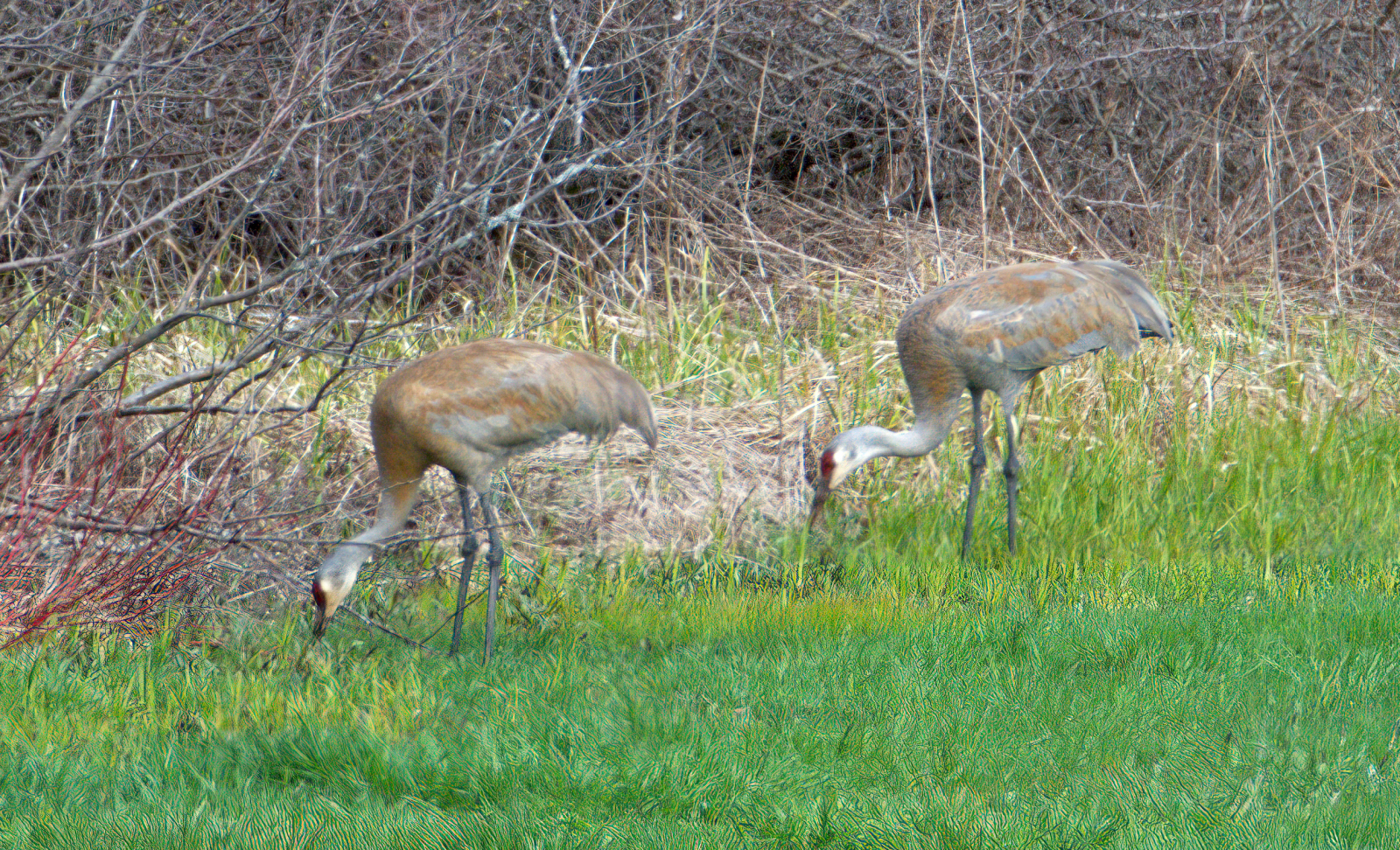
a female Ruby throated Hummingbird appear at his home Feeder at at Mary’s Point. It is the first Dave has seen this year, though he may have missed it during the afternoon when was busy elsewhere. May 2 isa few days earlier that he usually first sees one. (Editor’s note: although John and Dave lived near one another, these would be two different birds as Johns was a male) **Rhonda and Paul Langelaan found some SANDHILL CRANES atHarewood on Sunday to get nice photos on Sunday. They comment they were veryactively vocalizing and doing their dance routine. (Editor’s note: Harewood is located on Rte. 112, approximately 20 km northwest of the Irving Big Stop) **Brian Stone got up early on Sunday and photographed the deep red sunrise before driving out to route 112 to try to relocate the SANDHILL CRANES reported earlier by the Langelaans. He was able to locate them and watch them forage in the field for an hour before they flew off in search of an alternate field. They ended up in the corn stubble field at the south end of O'Neal Rd. where he joined other birders to see them for another extended period. (Editor’s note: note in Brian’s flight photos the very straightly held neck in flight in contrast to the Great Blue Heron) Brian then went to Wilson Marsh where his birding spirit was dampened by the strong, cold wind and dim, cloudy light. Not seeing anything out of the ordinary after a brief and uncomfortable walk he cut his visit short and left for warmer lands. Before leaving though he noticed a goose egg on the trail that appears to have ended up as some hungry critter's lunch. **Anita and David Cannon’s pair of EASTERN PHOEBE [Moucherolle phébi] are still present and very interested about a
potential nest site inside a veranda over their main door. Eastern Phoebes will often nest in areas such
as this if not too busy an area. It will
be very interesting to follow if the potential site of interest is taken. The Cannons are concerned they may start a
nest and abandon it but suspect the phoebes could not choose a better site to
be protected.
Nelson Poirier,
Nature Moncton